Photo Archives

1958
In the fall of 1958, the laminated wood arches first used to support the 1959 gym—and currently the Activity Center—arrived in Greenville from Minnesota, where they’d been fabricated. Here R. K. Johnson (1910-1971) sits atop eight of the sixteen arches sent via rail on two special flatcars. A circuitous route had been devised to avoid tunnels and low overpasses. The arches were presumably in the process of being transferred from rail cars to trucks.

1937
The Tempest (1937): Dr. Bob Jr. as Prospero and “Miss Holmes” (soon to be Mrs. Bob Jones Jr.) as Miranda, his daughter. They were married in June 1938.

In October 2010, Unusual Films shot a scene of Milltown Pride in the historic Pelzer Auditorium, a scene in which David Burke played Billy Sunday and Joel Robinson played his song leader Homer Rodeheaver. The trombone actually belonged to Rodeheaver and is in the BJU Archives. This film photo references a real photo taken of Rodeheaver and Sunday in Los Angeles in 1917.

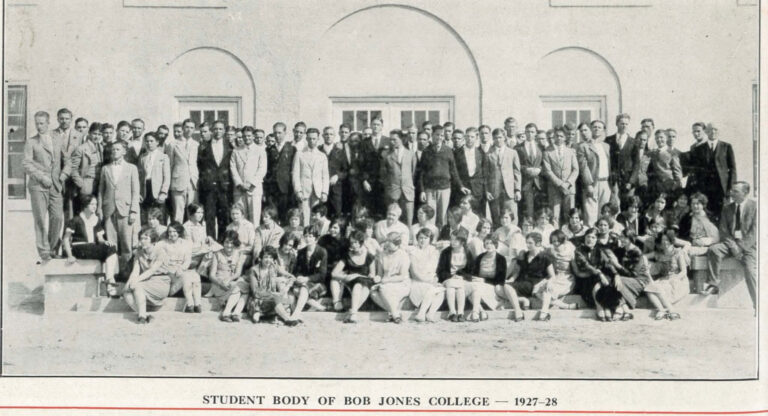
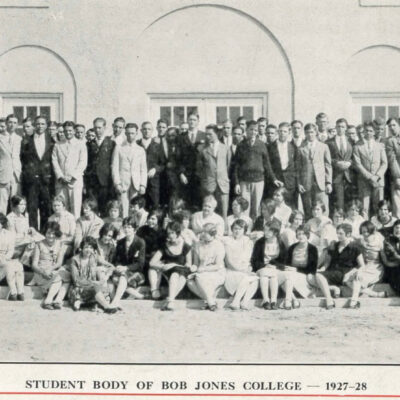
First BJC student body and faculty, 1927-28

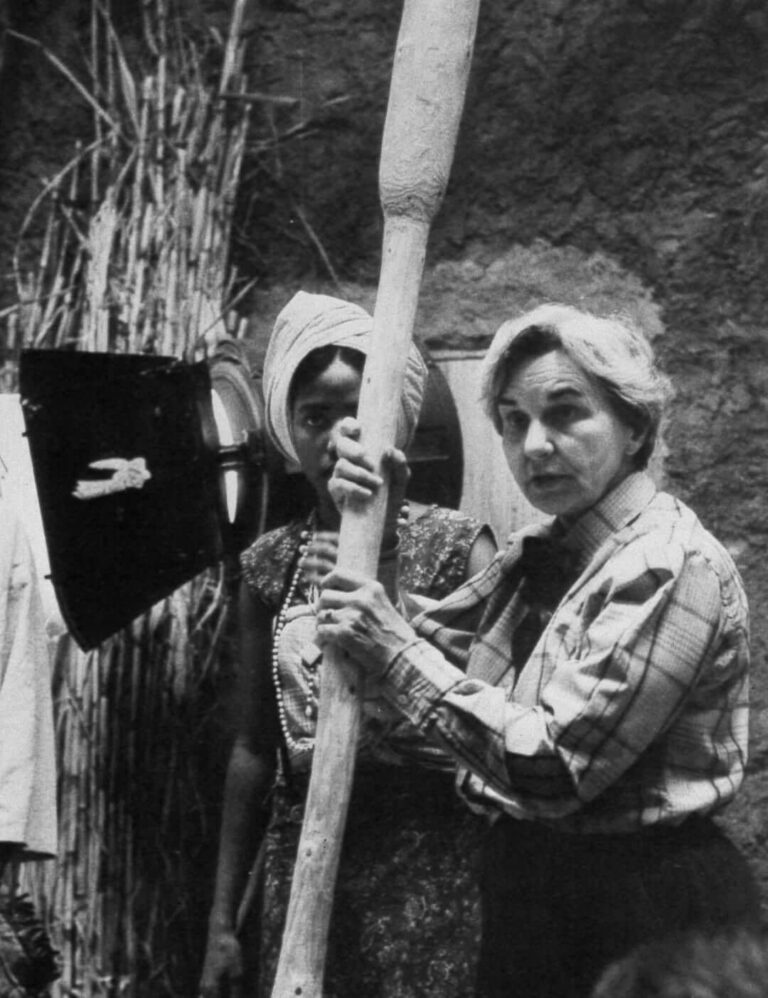
Mrs. Stenholm filming Beyond the Night, 1981-82.

1977
Registration at Mack Library, September 8, 1977, with Bruce McAllister holding the door.

1957
The practice studios (1947-1990) were on South Drive behind Johnson, today a parking lot across from the stadium. (Multiple attempts were made to get students to stop calling them “practice shacks,” none of them successful.)

Old Main, Cleveland campus, early spring. Dr. Bob Sr. at lower left.

2006

Little Moby’s Corner, the Cleveland version of a Student Center, 1940s.

Two campus postcards from the early 1950s: one of the Dining Common and the other of the Administration Building. These “linen” postcards, a type manufactured in the United States from the 1930s to the 1950s, weren’t made of linen but from paper with a high cotton rag content and given a textured surface that suggested linen. Created from black-and-white photos, the cards were retouched—sometimes with considerable artistic license—in saturated and exaggerated colors. These particular cards were published by the Asheville Postcard Company (1913-1977). In the mid-1950s, cards like these probably cost 5 cents apiece, plus 2 or 3 cents to mail.

1980
Library dedication, September 6, 1980. L to R: Alma Overbey, Margaret Bald, Joe Allen, Gene Elliott.

1997
Jones family, Faculty Body, Gold Rush Daze.

1980
Hanging the library chandelier, 1980. Photos taken by Gene Elliott, library director.

2007
Part of the front campus entry, nicknamed the Giraffe—photo taken in 2007 during BJU’s 80th year.

Alice Gingery, Joan Mulfinger, George Mulfinger, late 1960s

1967
Dale King (1930-2014) posing with an English class. A still from the promotional film Gateway to a Miracle (1967). Note the original, carpetless, concrete floor of the Alumni Building and the fact that King is resting his feet on a notebook, presumably to give him a better position on the edge of the desk during multiple takes.


1976
On July 3, 1976, BJU dedicated a memorial plaque on the former Florida campus as part of its 50th anniversary celebration.

1933
By every human measure, this should have been the end of a totally bankrupt school at the bottom of the Depression.

1961
Nemorino (Gail Gingery) buys elixir from Dr. Dulcamara (Dwight Gustafson).

1927
Spartan dorm room on the Florida campus.

In 1952, during a world tour of mission fields, Bob Jones Sr. presented honorary degrees to Generalissimo and Madame Chiang Kai-shek in Taipei, Taiwan. In return, Chiang gave BJU two dawn redwoods. Today you can buy a two-foot specimen online for somewhere between $25 and $100; but in 1952, they were truly exotic, having only recently been discovered in a remote valley in China, “living fossils” that attracted attention from botanists around the world. The BJU tree is a direct clone of one of those Chinese trees.
One of the two gift trees was planted by the library and soon died. The other one, planted just off Wade Hampton near the current Dining Common, is now the tallest tree on campus. Although Metasequoia glyptostroboides is the shortest of the redwoods and deciduous like the bald cypress, it’s a fast grower and has the potential to reach 165 feet—the height of a 15-story building—and live for hundreds of years.

1948
…pictured appropriately with two dictionaries. On the far left, Ernest Campbell (1923-2010), later a noted modernist theologian; on the far right, Otis Holmes (1920-2009), brother of Fannie May Jones. To his left is Heyward Wing-Hee Wong (1917-2003), later noted as a writer of Chinese hymns.
1966
Looks heavy enough to be an armored car. But then gas was only about 30¢ a gallon.

1995
Valentine’s Day promotion—a “kissing booth”—at the BJU Bookstore, 1995. In the photo, Shannon Simpson Milligan ’95 is passing out Hershey Kisses.

1964
As Dr. Bob Jones Sr.’s health declined, BJU faculty/staff were encouraged to honor his 80th birthday by sponsoring a 1964 trip around the world for him and his wife—an incongruous choice in view of his declining health and life-long disinterest in sightseeing. Dr. Bob was persuaded that his presence might encourage missionary alumni along the way, but he remained troubled that BJU employees had been pressured to give from their meager salaries. For weeks he badgered R. K. Johnson to find some way to return the money without hurting anyone’s feelings. “You work it out,” he said. “Give them a special bonus or something. I feel terrible about this.”
Photo taken at GSP, January 1964. L to R: Bob Jones III, Beneth Jones, Jon Jones, Mary Gaston Jones, Dr. Bob, and Fannie May Jones.

1928

1934
Bob Jones Sr. with Billy and Nell Sunday, Cleveland campus, 1934.

2005

An aerial view of front campus in the early 1990s. Notice this is before the parking garage was constructed behind Rodeheaver Auditorium.

1953


Photo Archives
Born in Virginia, and orphaned at eight, Johnson almost immediately became a student leader when he arrived at BJC in 1931. He was elected president of the 1935 senior class. While he was still a student, Bob Jones Sr. named Johnson the college business manager, and he retained that title for the rest of his life. Johnson’s pay-as-you-go business policy played a significant role in helping BJU survive the loss of its federal tax exemption in 1983. Before his death from a heart attack in 1971, Johnson wrote a commemorative biography of Bob Jones Sr., which includes a chapter on the construction of the Greenville campus in which Johnson himself played a significant role. After his death, a men’s residence hall was named in his memory.
Born in Hocking County, Ohio, Homer Rodeheaver was reared in eastern Tennessee and there became familiar with local mountain ballads and Negro spirituals. He learned to play trombone while attending Ohio Wesleyan College. From 1910 to 1930, he served as music director for evangelist Billy Sunday, but he made much more money as a pioneer gospel recording artist and music publisher. Will Rogers said, “Rody is the fellow that can make you sing whether you want to or not. I think he has more terrible voices in what was supposed to be unison than any man in the world. Everyone sings for Rody!” Rodeheaver made a large contribution toward the construction of the Auditorium, and it is named in his honor.
The son of a Cincinnati shoemaker, Charles Brokenshire displayed a remarkable gift for languages and distinguished himself as a biblical scholar. He graduated from Marietta College, summa cum laude, in 1907 and thereafter studied with some of the finest conservative scholars at Princeton Seminary. Though he nearly completed a PhD twice, he ultimately did not finish either program. Alma College awarded him an honorary doctorate. Brokenshire came to Bob Jones College in 1943, and he served until he died the day he turned in his final grades in 1954. A men’s residence hall is named in his honor. Brokenshire was essentially the founder of BJU’s Graduate School of Religion.